
Navigating Charles de Gaulle Airport into Paris, and onward to Bordeaux by train
Arriving at Charles de Gaulle Airport and continuing to Bordeaux by train sounds complicated when you first look at a map of Paris. In reality, it is quite manageable—as long as you understand one particularly important Parisian quirk before you begin.
Gare Montparnasse and Montparnasse–Bienvenüe are not quite the same thing.
That distinction alone can save you a surprising amount of stress, especially when you are pulling a suitcase behind you.
First, Know Where You Are Going
The high-speed trains to Bordeaux leave from Paris Gare Montparnasse, usually listed on your SNCF ticket as Paris Montparnasse – Hall 1 & 2. Most direct TGVs make the journey from Paris to Bordeaux Saint-Jean in roughly two hours and ten minutes.
The Métro station serving the area, however, is called Montparnasse–Bienvenüe, and is located a solid fifteen minute walk to the north of the train station.
They are connected, but do not picture stepping off the Métro and immediately seeing your TGV waiting across the platform. Montparnasse–Bienvenüe is a large underground Métro complex serving several lines, with long corridors, moving walkways, escalators, and multiple exits. Depending on the Métro line you arrive on, you may have a substantial walk before reaching the SNCF station itself.
This is one of those situations where Parisian geography is technically logical but not necessarily luggage-friendly.

If your ticket says Paris Montparnasse – Hall 1 & 2, your ultimate goal is the main TGV station at 17 Boulevard de Vaugirard, not simply the Montparnasse neighborhood or the first street exit marked “Montparnasse” that you encounter. Gare Montparnasse actually has several halls on different levels, including Hall 1, Hall 2 above the tracks, and the more distant Hall 3/Vaugirard.
For Bordeaux, you will most commonly be using Hall 1 or Hall 2.
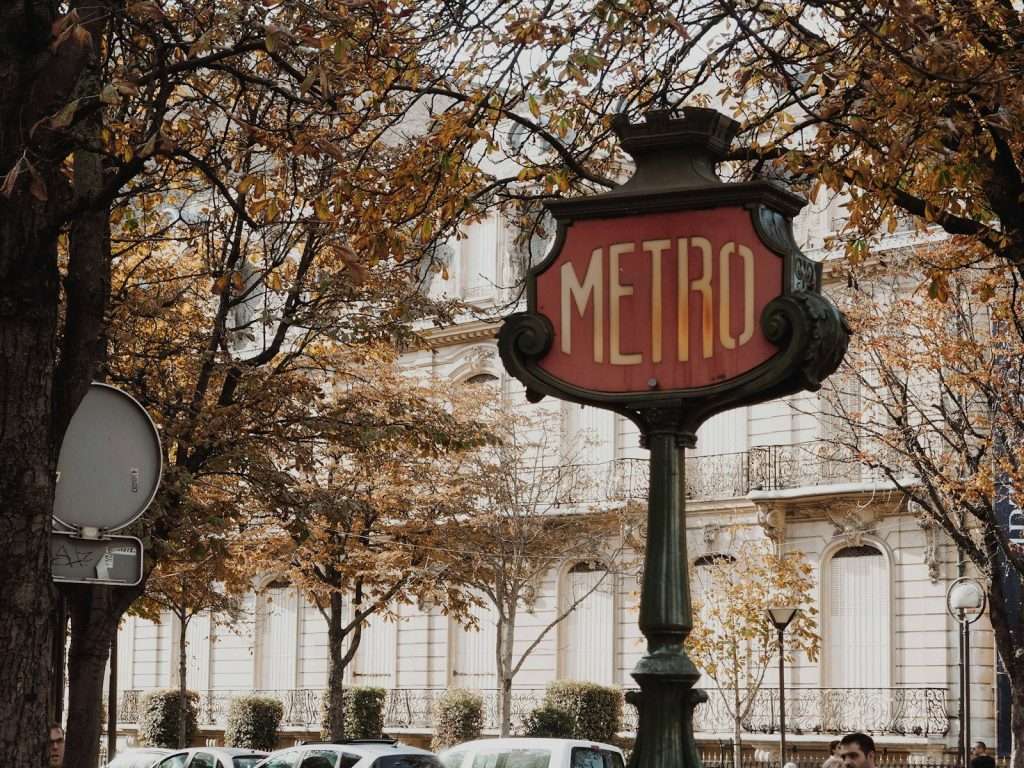
Option One to get to the train station: RER B and Métro — Usually the Best Value
For one or two reasonably mobile travelers with manageable luggage, the RER is often our preferred way to cross Paris.
From Charles de Gaulle, follow the signs for Paris par Train / RER B. Depending on your arrival terminal, you will board at either the Terminal 2 station or the CDG 1 station serving Terminals 1 and 3.
The 2026 Paris Region–Airports ticket costs €14 per person and covers the rail journey from CDG into Paris.
For Montparnasse, we particularly like this route:
CDG → RER B → Denfert-Rochereau → Métro Line 6 → Montparnasse–Bienvenüe
Take the RER B toward Paris and get off at Denfert-Rochereau. From there, transfer to Métro Line 6 in the direction of Charles de Gaulle–Étoile and ride three stops to Montparnasse–Bienvenüe.
We prefer this over making some of the more complicated central-Paris transfers because Denfert-Rochereau is relatively straightforward, and Line 6 brings you into the Montparnasse complex without requiring you to cross the center of Paris underground.
Once you arrive at Montparnasse–Bienvenüe, however, do not mentally declare victory yet. Follow the SNCF and Gare Montparnasse signs and allow time for the walk through the station complex.
SNCF itself notes walking routes of around ten minutes between some parts of the Métro access area and the station halls.
With luggage, we would budget at least 15 minutes from stepping off the Métro until you are comfortably inside the TGV portion of Gare Montparnasse, particularly if this is your first visit.
The RER/Métro option makes the most sense when you are traveling light, the weather is decent, everyone in your party is comfortable walking and using escalators, and you don’t mind navigating one transfer.
It becomes substantially less appealing when you have three suitcases, a wine case, a tired child, a mobility limitation, or several travelers trying to stay together.

Option Two: An Official Paris Taxi — Often Better Than People Realize
Americans sometimes automatically assume that taking a taxi from CDG across Paris will be extravagantly expensive. For several people traveling together, it may actually be one of the best values.
Paris taxis use a regulated flat airport fare. In 2026, the official fixed price from Charles de Gaulle to the Left Bank, where Gare Montparnasse is located, is €65 per vehicle. There is no luggage surcharge. A passenger surcharge of €5.50 can begin with the fifth passenger.
Do the math.
For one traveler, €65 versus €14 makes the RER an easy winner.
For two people, the taxi is effectively €32.50 each.
For three, about €21.70 each.
For four, it is only about €16.25 per person—barely more than public transportation.
And the taxi picks you up outside the terminal and deposits you directly at Gare Montparnasse.
For three or four travelers with luggage, a taxi becomes very attractive indeed.
The great variable, of course, is Paris traffic. The RER doesn’t care very much whether the périphérique is clogged. A taxi most certainly does.
On a quiet Sunday morning, the taxi can be wonderfully easy. During weekday rush hour, the same trip can involve a great deal of staring at brake lights while wondering just how committed the French are to that 4:00 TGV departure.
Always use the official airport taxi rank. Do not accept a ride from anyone walking through the terminal asking whether you need a taxi. Official taxi stands are located outside the arrivals areas and are clearly marked.
For larger parties, or travelers carrying substantial luggage, arranging a larger taxi or private van in advance can be worthwhile. This is particularly true for a Flying Grape traveler who might be carrying both a normal suitcase and an empty wine suitcase destined to come home considerably heavier.
The Weather Matters More Than You Think
Your transportation choice should not necessarily be the same every time you visit Paris.
Imagine two travelers arriving on a beautiful April morning with one rolling carry-on each. The RER is easy, inexpensive, and part of the fun of arriving in France.
Now picture those same travelers after an overnight flight, dragging two large suitcases and a wine carrier through a cold Paris downpour.
Spend the €65.
There is no prize awarded at Gare Montparnasse for having suffered unnecessarily.
Hot weather can make the same difference. Parisian Métro stations and trains can become warm, crowded, and surprisingly uncomfortable when you are hauling luggage. Escalators occasionally fail. Elevators exist but may require a less direct route. SNCF’s own current station information shows numerous lifts and escalators at Montparnasse—but also routinely lists some temporarily out of service.
Transportation decisions in Paris should therefore involve more than price. Consider people, bags, weather, mobility, traffic, and time.
Our Rule of Thumb
One person: Take the RER unless you have lots of luggage or mobility concerns.
Two people: Usually take the RER, but a taxi becomes tempting with heavy luggage, lousy weather, or fatigue.
Three people: Start seriously considering the taxi.
Four people: The taxi is often the obvious choice, particularly with luggage.
Five or more: Look into a larger taxi or prearranged van rather than trying to move the entire group through the RER together.
There is another factor that occasionally trumps all of them: how much time you have before your TGV.
If Paris traffic is terrible and your departure is getting close, rail may be safer.
If you have plenty of time and four people carrying bags, take the taxi and enjoy the simplicity.

Arriving at Gare Montparnasse
I’ve provided a bunch of info here, but here’s a web page that details the train station even further.
Gare Montparnasse can feel enormous the first time you enter it. It isn’t an airport, however, and you don’t need to treat it like one.
There is no reason to arrive two hours before a normal TGV departure.
But arriving 30 to 45 minutes early is extremely sensible for an unfamiliar traveler, because you need time to orient yourself, use the restroom, grab some food or coffee, and determine where your train will depart.
This is where an important French railroad word enters your vocabulary:
Voie = Track.
Large electronic departure boards list your train by destination, departure time, train number, and eventually the voie.
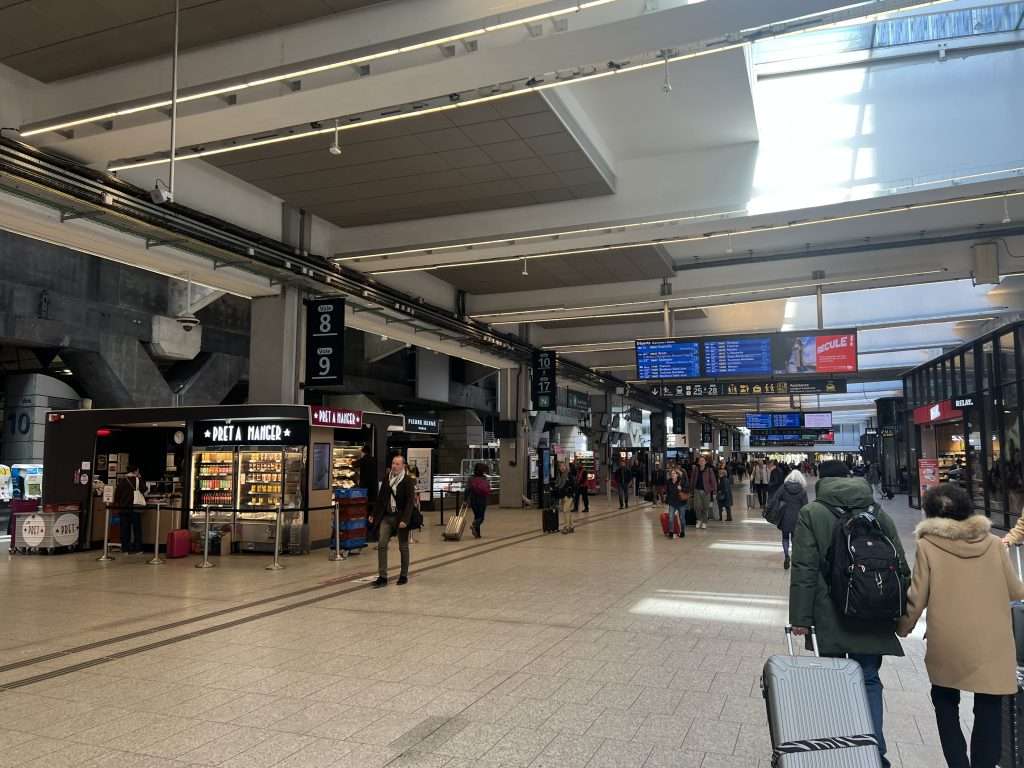
Your ticket might say something such as:
TGV INOUI 8511
Paris Montparnasse → Bordeaux Saint-Jean
15:05
Look for the train number, not just “Bordeaux.”
That is particularly useful because some trains continue beyond Bordeaux, or displays may emphasize another final destination. Your train number is definitive.
SNCF currently operates numerous direct services between Montparnasse and Bordeaux each day, with the fastest taking only about 2 hours and 8–10 minutes.
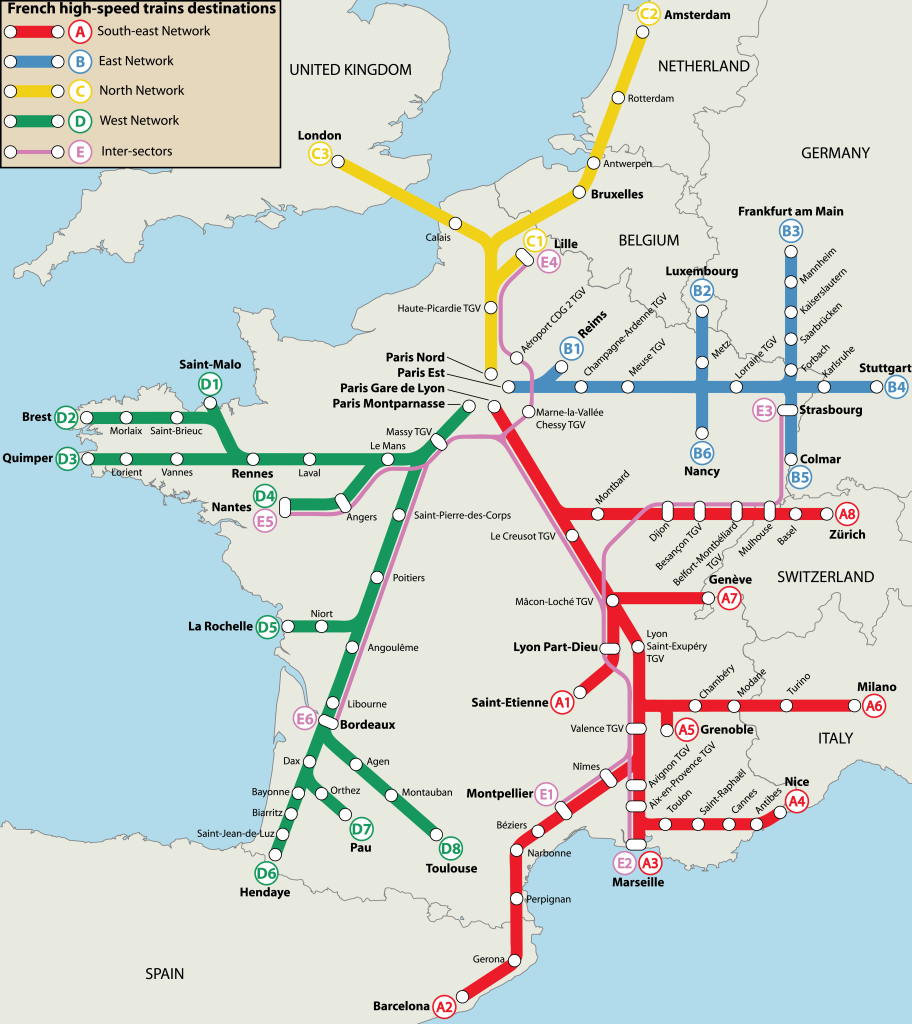
Don’t Panic When Your Track Isn’t Listed (as long as you know you’re at the right station)
One thing that unnerves first-time French train travelers is arriving at the station thirty or forty minutes early and seeing:
Voie: —
Nothing is wrong.
French stations frequently announce the precise platform relatively close to departure (sometimes just five or ten minutes). Watch the departure board and listen for announcements.
When the voie finally appears, you will often see a substantial portion of the waiting crowd begin moving simultaneously.
That is your cue.
You don’t have to sprint, but don’t wander off for another espresso either. You want to get to the train, find the right car, stash your luggage, and find the right seat. And when it’s time to leave, it’s time to leave, no matter what side of the train’s doors you are on.
Hall 1, Hall 2…and Hall 3
This is another reason to look carefully at your ticket.
Gare Montparnasse is actually divided into multiple sections. Hall 1 is the primary track-level departure hall. Hall 2sits above the platforms and gives access to tracks 1–24, while Hall 3 – Vaugirard is farther away at the end of the station complex. SNCF specifically recommends escalator access via track 24 when moving toward Hall 2 with luggage.
Most Paris–Bordeaux TGV services are currently listed as departing from Paris Montparnasse – Hall 1 & 2.
That is reassuring.
But always read the ticket.
If you ever see Hall 3 / Vaugirard, take it seriously and allow additional walking time.
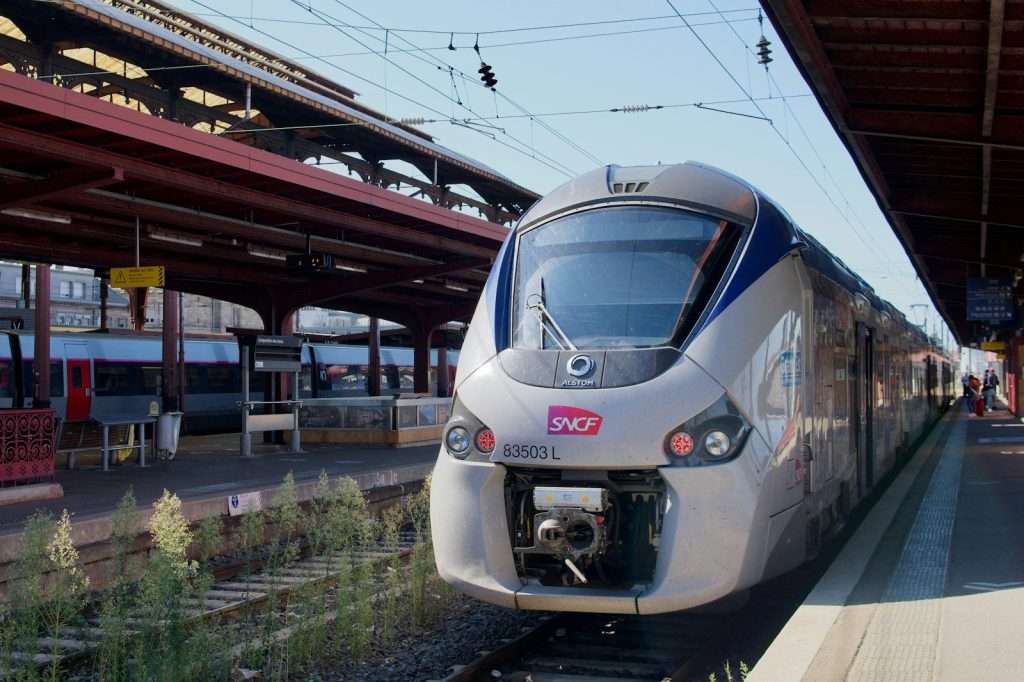
Finding Your Car Once the Track Appears
Your French train ticket will normally show both a voiture and a place.
Voiture = car number.
Place = seat number.
Once the platform is announced, screens and signs help indicate approximately where each numbered train car will stop.
Pay attention to this.
French TGVs can be very long. Boarding at the completely wrong end of the train and trying to drag several suitcases through eight train cars is an excellent way to begin your vacation muttering things that would disappoint your high-school French teacher.
Find your voiture first, board there, and then find your seat.
If you have large luggage, board calmly but efficiently. Luggage racks near the entrances can fill quickly.
Leave Yourself a Realistic Connection
One of the biggest mistakes travelers make when combining an international flight with a separately booked train is assuming that an 11:00 scheduled landing means they will be standing outside CDG at 11:15.
It doesn’t.
Your plane must taxi to the gate. You must deplane. You may have immigration. Checked luggage must appear. Then you have to find transportation and cross one of Europe’s largest cities.
For a separate CDG-to-Bordeaux connection, we prefer a generous cushion rather than an ambitious one.
A four-hour interval between scheduled arrival at CDG and TGV departure from Montparnasse is not ridiculous. It is comfortable.
And if everything goes beautifully, you have just earned yourself something wonderful: lunch in Paris.
There are worse travel problems to have.
Coming in 2027: The CDG Express
Paris is about to gain another airport transportation option, and it will be particularly interesting for travelers arriving for future Flying Grape trips.
The new CDG Express is scheduled to begin service March 28, 2027. It will run nonstop between Charles de Gaulle Airport and Gare de l’Est in approximately 20 minutes, with trains every 15 minutes from roughly 5:00 a.m. until midnight. The announced standard fare is €25 one way.
That sounds fantastic—and it is.
But there is an important catch for Bordeaux travelers:
It does not go to Gare Montparnasse.
It goes to Gare de l’Est, on the opposite side of central Paris.
From Gare de l’Est, however, there is a useful connection: Métro Line 4 runs directly from Gare de l’Est to Montparnasse–Bienvenüe.
So the future journey becomes:
CDG → CDG Express → Gare de l’Est → Métro Line 4 → Montparnasse–Bienvenüe → walk to Gare Montparnasse
That has advantages. The airport portion should be fast, predictable, frequent, purpose-built for luggage, and unaffected by Paris road traffic.
But for a traveler ultimately heading to Bordeaux, it still requires carrying luggage through Gare de l’Est, entering the Métro system, riding across Paris, and making the Montparnasse–Bienvenüe-to-Gare-Montparnasse walk.
And it will cost considerably more than the RER.
For one traveler who values predictability, it may be wonderful.
For four people, the math becomes interesting: four €25 CDG Express tickets already total €100 before the Métro, while an official taxi from CDG to Montparnasse currently costs €65 for the vehicle.
That is why the newest transportation option is not automatically the best transportation option.
RER B vs. CDG Express
The existing RER B is fundamentally a commuter train. It serves airport passengers, suburban residents, workers, students, and everyone else traveling along the route. It makes stops, can become busy, and was never designed solely around travelers carrying luggage.
Its enormous advantages are price and connectivity.
In 2026 the airport fare is €14, and the RER deposits you directly into the Paris transit network.
The CDG Express, by contrast, will be an airport train: faster, nonstop, more predictable, and designed specifically to transport passengers between CDG and central Paris.
If your hotel is near Gare de l’Est or the northern side of central Paris, that will be a major improvement.
For travelers immediately continuing to Gare Montparnasse and Bordeaux, the advantage is less overwhelming because Gare de l’Est is not your final Paris destination.
We suspect many Flying Grape travelers will continue to find themselves choosing between two very sensible options:
RER B for one or two people traveling relatively light.
Taxi or van for several people or anyone carrying significant luggage.
And the CDG Express will become an excellent third choice for travelers who place the highest value on speed and predictability.

One Final Piece of Advice: Don’t Rush Paris
If you have a long connection between CDG and your Bordeaux train, don’t necessarily treat it as dead time.
Get to Montparnasse early. Store your luggage if appropriate. Find a café. Eat something French. Have your first glass of wine.
The temptation when traveling is to schedule everything as tightly as possible. We prefer the opposite approach.
Build room into the journey.
Travel is much more enjoyable when a delayed suitcase is an inconvenience rather than a catastrophe, when navigating the wrong corridor at Montparnasse becomes a funny story rather than a missed train, and when arriving early means you suddenly have ninety minutes to sit at a Paris café.
After all, the trip to Bordeaux is not something you have to endure before the vacation begins.
The trip to Bordeaux is already part of the vacation.